
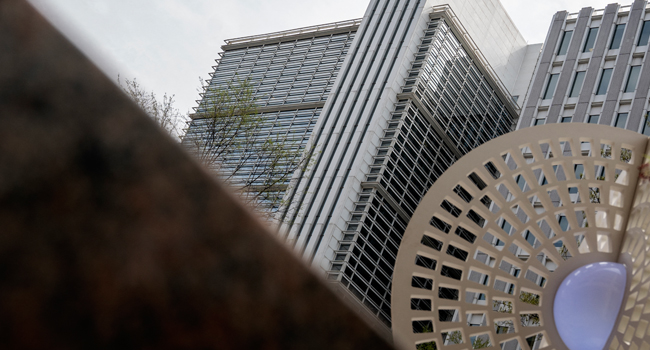
The World Bank headquarters in Washington, DC. Photo: Stefani Reynolds/AFP via Channels Television.
The International Monetary Fund (IMF) has called for cash transfers and targeted, temporary income support for the most vulnerable households in Nigeria.
The call was made as the Fund released its October 2026 World Economic Outlook at the ongoing Annual Meetings of the IMF and World Bank Group in Bangkok, Thailand.
According to the report, the Fund noted that the transfers will help reduce poverty and improve food security despite Nigeria's high inflation rate, which continues to squeeze household budgets across the country.
It also called on the Central Bank of Nigeria to ensure inflation returns to the country's policy-targeted point, arguing that price stability is central to any recovery in living standards.
"Inflation is high, but economic activity is being constrained or reduced by the shock. This is where the central bank needs to manage the trade-off. It must ensure that inflation returns to target within the policy horizon, which we typically consider to be two to three years," the Fund said.
"This should be accompanied by a credible medium-term fiscal framework. That framework should focus on improving the quality of public expenditure and strengthening revenue collection," it added.
Speaking at the launch, the Economic Counsellor at the Fund, Silvana Tenreyro, projected Nigeria's growth at 4.3 per cent by 2027, outpacing advanced economies like the United Kingdom, Canada and Germany.
The IMF acknowledged that although growth has held up as an energy exporter, living costs in Nigeria remain very high.
"These are essential items, and their prices have risen significantly. The question is how to address these pressures while ensuring that the burden does not fall disproportionately on vulnerable households," it noted.
The Fund projected global economic growth at 3 per cent in 2026, with a call for African governments to protect vulnerable households as global headwinds persist.
According to the Fund, a major energy supply shock linked to the conflict in the Strait of Hormuz has pushed oil prices up by 32 per cent this year, driving global inflation to 4.7 per cent and reversing two years of progress on disinflation. Massive investment in artificial intelligence, including the construction of data centres, is helping keep global growth afloat, it said.
Global growth is expected to rebound to 3.4 per cent in 2027 if the Strait of Hormuz reopens fully by March next year, the report noted, adding that Asia will account for 59 per cent of global growth in 2026, led by India and Indonesia.
The IMF also warned of new financial risks, with global hedge fund assets tripling to $13 trillion since 2013, alongside risks of an AI investment correction and trade fragmentation.
The 2026 Annual Meetings in Bangkok marked the return of the summit to Thailand for the first time in 35 years, with over 10,000 delegates in attendance.
Source: Channels Television





0 Comments